Decentralized Crypto Wallet: What It Is And How To Choose One

Anyone who has seen an exchange pause withdrawals, freeze an account, or simply go offline while you need your funds that’s why so many people are moving to self custody. A decentralized crypto wallet gives you control over your coins, rather than a company holding your coins.
There are true costs associated with that control and most articles online cover that up. This guide will clarify what a decentralized wallet is, its limitations, and provide a checklist for selecting a wallet in 2026.
A decentralized wallet (also called non-custodial or self-custodial) is a crypto wallet whose private keys you hold instead of a company. The coins remain on the blockchain. The wallet contains the keys which allow you to sign transactions. No company can freeze your money or recover your money for you; your backup is your only chance.
What Is A Decentralized Crypto Wallet?
In the cryptocurrency Industry, a decentralized wallet is generally meant to be a self-custody or non-custodial wallet. The three sentences all refer to the same concept. It's up to you to keep your private keys and not an exchange or a company.
What Does Decentralized Mean For A Wallet?
It's kind of like the difference between renting a safety deposit box at a bank versus a home safe. The bank box is used by the bank and subject to their control (and limitation). With your own safe, you can only access your own safe, and you're the only one who decides who enters.
This is the same concept a decentralized wallet has, but the process is somewhat more complicated. The application does not keep your cryptocurrency assets for you. It just provides you the tools that you could control yourself.
Is a decentralized wallet the same as a self-custody or non-custodial wallet?
Yes, in everyday use. These three terms are confused by wallet brands, exchanges, and wallet reviewers. The following are all indicators that means you have the keys in your wallet, if they are in any of their marketing.
There's a little technical detail to learn. While a non-custodial wallet does not necessarily mean it does not rely on company-operated servers for checking balances or sending a transaction to the network, it does mean that it relies on the servers and risks being compromised. A non-custodial wallet is not necessarily one that does not use company-owned servers to perform services such as checking your balance or sending a transaction to the network, but using those servers does mean it has the ability to be compromised.
That doesn't take away your ownership of your funds, but it's a legitimate question to ask. You can read more in our guide on what a self-custody wallet actually means.
Do your coins actually live inside the wallet?
Not exactly, this is a common mistake for many beginners. Your coins are NOT stored in the app on your phone, but are on the blockchain itself. The wallet application stores your private keys, which are what let you prove ownership and approve transactions.
Let's look at it this way, the blockchain is like a public ledger of who owns what and your wallet would be like a key used to sign your name on that ledger. Loss the key, and you lose the ability to sign even though the record is still there.
How Does A Decentralized Wallet Work?
When you understand the concept that your wallet contains keys and not coins, the rest starts to make sense.
What is a seed phrase and why does it matter so much?
The first time you create a decentralized wallet, it creates a recovery phrase, typically 12 or 24 random words in a particular order. This is referred to as a seed phrase, and uses BIP-39, an industry-standard for wallets to read the same seed phrase.
This phrase is the principal key to your funds. Your wallet can be accessed by anyone who has the keys from anywhere, on any device. There's no customer support line to get your money back if you lose it as well as your device. Like almost all mobile self-custody wallets, Oppi Wallet employs a 12-word seed phrase.
Remember – writing this out on paper and keeping it private and safe is not an option. It is the most crucial step if you're using a decentralized wallet.
What happens when you send crypto ?
Your wallet creates a digital signature and signs each transaction with your private key when you transact money to someone. That signed transaction is then sent to the blockchain network to be confirmed and added to the blockchain.
This will generally incur a small network fee in addition to any fees that the wallet app may charge for other services, such as swaps. Most wallets, including the send crypto feature in Oppi Wallet, show you this fee before you confirm, so there are no surprises.
Decentralized Vs Centralized Wallet: What Is The Difference?
| Points |
Decentralized (self-custody) wallet |
Centralized (exchange) wallet |
|
Who holds the keys |
You do |
The exchange does |
|
Recovery if you lose access |
Only your seed phrase can restore it |
Exchange support can often help |
|
KYC required to use it |
Usually not for the wallet itself |
Yes, to open and fund an account |
|
Can your balance be frozen |
Not by the wallet provider |
Yes, the exchange can restrict accounts |
|
Access to swaps and other apps |
Often built in or connectable |
Limited to what the exchange offers |
|
Main risk |
You are responsible for backups and safe habits |
You are trusting the exchange's security and solvency |
|
Best for |
Holding funds long term and staying in control |
Active trading and quick fiat conversions |
When is an exchange account the better choice?
To be transparent, self-custody is not always the right answer. If you trade frequently, an exchange account can be faster and more convenient, since you are not managing your own keys for every trade.
The honest trade-off is this: convenience on an exchange comes with counterparty risk, meaning you are trusting that company to stay solvent and keep your account accessible. Many people use both, trading on an exchange and moving longer-term holdings into self-custody. Our comparison of crypto wallets and exchanges breaks this down in more detail.
What A Decentralized Wallet Does Not Protect You From
This is a part that most guides avoid and it has an impact. Self-custody eliminates one type of risk - the risk of the company managing the funds - but it does not eliminate all risk.
Can USDT or USDC stablecoins be frozen in a self-custody wallet?
This comes as a shock to many, but in some instances, yes. Companies issue stablecoins such as USDT and USDC, and if necessary, the companies that issue them can blacklist certain wallet addresses at the token level due to legal obligations. This could be the case even if you have a completely self-custody wallet.
It is not a limitation of a specific wallet. It is a basic principle of stablecoins no matter where the wallet is located and whether it's a decentralized wallet app or a centralized one. For more detail on understanding stablecoins, check out our guide on how do stablecoins work?
Is a decentralized wallet anonymous and untraceable?
No and this is a common misconception. The wallet addresses and transactions are stored on a public blockchain which is open for all to view. Your activity is not associated with your identity but as soon as you associate your wallet with an activity that requires identity verification, such as buying crypto on a linked card or on an on-ramp, that activity starts being linked to your wallet.
Does a decentralized wallet depend on company servers?
Yes, in most instances as your keys remain stored on your own device. Usually the wallet apps communicate with the backend infrastructure to check wallet balances, show prices and submit the signed transactions to the blockchain network.
You keep your keys, your ownership and your convenience features, but it all relies on the company's systems running.
Is it possible to hack a decentralized wallet?
The encryption of blockchain is very difficult to break through directly. In reality, nearly every fund loss occurs due to human-caused elements, such as phishing scams, fake support staff, malware installed on a device, a leaked seed phrase, or clicking on a transaction without reading its instructions.
According to industry tracking platform Chainalysis, there were approximately 158,000 personal wallet hacks in 2025, impacting around 80,000 victims for a total loss of approximately $713 million. This isn't to say that decentralized wallets are not safe. That's because your own habits form the true layer of security.
What Types Of Decentralized Wallets Are There?
Not every self-custody wallet is exactly the same. A concise summary of the primary types you'll come across.
Mobile and desktop wallets (hot)
These are mobile wallets that are downloaded onto smartphones or their computers. They remain connected with the internet, enabling ease of everyday use, swapping, sending and receiving.
Browser extension wallets
They run directly in your browser and are commonly utilized for direct interaction with decentralized applications (dApps), particularly in the DeFi sector and trading.
Hardware wallets (cold)
These are physical hardware devices holding your private keys with them at all times. They're usually the safest way to store larger quantities, which are not accessed frequently or on a daily basis.
Seedless MPC and smart contract wallets
The newer category includes technology dubbed multi-party computation, or MPC, which divides your key into parts and stores them to numerous places rather than using a single seed phrase. This can help the recovery process, but it is not like a regular wallet, so it is important for you to find out first before making the switch.
How To Choose A Decentralized Crypto Wallet
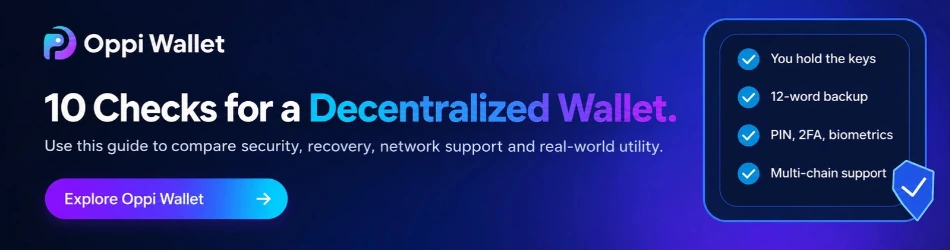
10-point checklist for 2026
There are many different wallets to choose from, so refer to this list to compare any wallet you're thinking of using, not just the ones listed here.
1. No business can reveal, access or freeze your funds since the private keys are held by you only.
2. The method of recovery is clear, and can be tested for before needed.
3. Reports of security audits are public, dated and issued by a familiar organization.
4. The application provides a strong level of device security with PIN, fingerprint and 2-factor authentication.
5. It is compatible with the specific blockchain and tokens you intend to use.
6. Service charges are shown clearly, and network charges separated from the service charges.
7. The interface is designed to be comfortable with technology, and not an expert.
8. All the claimed regulated registrations are named and checkable.
9. The wallet is known to remain secure and always has the latest app version.
10. Extra features such as swaps, or a linked crypto card, accompany how you really intend to use crypto.
How to conduct a wallet security audit?
The audit report is typically located on the wallet's official website, typically in a section dedicated to security or trust. Make sure that the auditing firm is reputable and find out the date of the audit as that may have been performed a long time ago and the app may have changed since then.
How do you make sure you are downloading the real app?
Never go directly to an app store to download an app, there are fake copycat apps out there, only download from the wallet site. Once there, click the official link to the App Store or Google Play page, and check to be sure the name of the publisher is the real company's name before installing anything on your device.
Should you pick a wallet with built-in swaps or a card?
This is based on your crypto use. A wallet that has an integrated swap crypto is useful for those who want to switch from one token to another without any hassles of moving funds among various wallet applications.
When choosing a wallet to spend crypto like cash, see if there is a linked card. For example, is it possible to have a virtual crypto card and a physical card, like Oppi Wallet, which has both crypto debit cards that are compatible with the Visa network.
It is important to comprehend this; the person who buys the card must submit identification and after the loading of the card's funds, the person's spendable card credit is distinct from the person's self-custody wallet's funds. You have self-custodied your wallet up until that top up step.
Some features and availability of cards may differ as per countries so it is important to know the availability level in your country.
Which Decentralized Wallet Is Best For Which Type Of User?
All of the decentralized crypto wallets listed here are legitimate self-custody options. It is based on their preference, whether it's simplicity, daily spending, or getting access to DeFi. This is just a starting point, as features and chain support are subject to change, and we recommend reading each wallet's official page before making a decision.
Here you will see 7 best list of decentralized wallets -
|
Wallet |
Type |
Chains supported |
Recovery model |
Standout feature |
Trade-off |
|
Mobile |
Ethereum, BNB Chain, Polygon, TRON, and Solana |
Seed phrase |
Multi-chain wallet with swaps and a Visa network card |
No fiat buy or sell inside the app |
|
|
MetaMask |
Browser extension, mobile |
Ethereum and other EVM chains |
Seed phrase |
Deep dApp and DeFi access |
Mainly built around EVM chains |
|
Phantom |
Browser extension, mobile |
Solana, with multi-chain support added over time |
Seed phrase |
Fast, smooth Solana experience |
Started Solana-first |
|
Exodus |
Desktop, mobile |
Multi-chain |
Seed phrase |
Simple, beginner-friendly design |
Fewer advanced DeFi tools |
|
Trust Wallet |
Mobile |
Broad multi-chain support |
Seed phrase |
Wide token and chain coverage |
Can feel feature-heavy for beginners |
|
Zengo |
Mobile |
Multi-chain |
Seedless MPC recovery |
No traditional seed phrase to lose |
Different recovery process to learn |
|
Ledger or Trezor |
Hardware |
Multi-chain |
Seed phrase, kept offline |
Keys never touch the internet |
Less convenient for frequent use |
As of October 2026, Oppi Wallet is able to support over 40 cryptocurrencies, including BTC, ETH, USDT, and USDC, and is available in more than 200 countries. It is essentially not an exchange and buying and selling cryptocurrency using fiat currency is not its feature.
We have taken time to compare Oppi Wallet and Trust Wallet in detail. If you are thinking about it comparatively, then this is for you.
How To Set Up A Decentralized Wallet (Step By Step)
After you select a decentralized wallet for crypto, it is as important to set it up correctly as the selection itself.
1. Only download the app from an official website of the wallet or a verified listing on the app store.
2. Create your wallet and take note of which blockchain networks it works with.
3. Record your seed phrase on paper or a metal back-up - not on your phone or screen.
4. Test your back-up by restoring it on another device before funding the wallet to make sure it is working.
5. Enable all protection such as PIN, biometrics and two factor authentication.
6. Send a small test transaction first and use the receive crypto function in your wallet to generate the correct address.
7. When that test transaction is received safely, move the remaining funds.
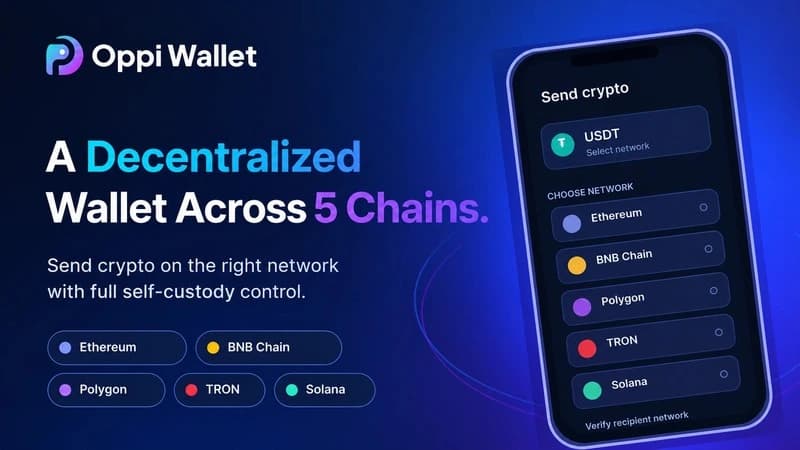
Another caution: be sure to send it to the right network. For instance, USDT is available on multiple blockchains, and transferring cross-chain funds to the incorrect blockchain may mean they are lost forever.
What Are The Most Common Decentralized Wallet Mistakes?
It isn't complicated attacks that cause most losses, but rather simple errors done repeatedly.
-
Keeping a seed phrase digitally, in a notes app, email or cloud photo backup.
-
Either approving or giving permission without reading the actual transaction.
-
Getting a message from a person claim to be wallet support and requesting your seed phrase.
-
A mis-transfer of funds to an incorrect blockchain network.
-
Not having two distinct hot wallets but having your entire balance in one.
Our guide to common crypto mistakes beginners make goes into more detail on how to avoid these.
Frequently Asked Questions
Is a decentralized wallet safer than an exchange?
It eliminates the possibility of an exchange freezing or losing your money, but it does place responsibility on you. Your backup habits and everyday caution become the main line of defense.
Can a decentralized wallet be hacked?
It is very difficult to crack the blockchain directly. Losses typically occur via phishing, malware, compromised seed phrase or by clicking or approving something bad, not wallet technology failures.
Is it possible to track a decentralized wallet?
Yes. Blockchain is public, so are wallet addresses and transactions. The address is primarily used to associate identity to an address by exchanges, cards or other services that need to be verified.
Is Oppi wallet, Trust wallet or MetaMask decentralized?
These are self-custody wallets and you'll have the keys. Although they keep your money in your control they, like most wallet apps, also require some service and support by the companies that operate them.
Do I need KYC to use a decentralized wallet?
Typically not for the wallet. Usually when you purchase cryptocurrencies with normal currency or with an associated spending card, identification verification steps into play.
Are decentralized wallets free to use?
Most wallet applications are free to download and use. You will have to continue paying network fees for transactions and also sometimes for swaps or card services.
What happens if I lose my phone?
Your seed phrase can be used to restore your wallet on a new device. Otherwise, no company or support team will be able to get your money back for you.
Can I move crypto from an exchange into a decentralized wallet?
Yes. Try sending a tiny amount first on the proper network and get a confirmation and then send the remainder of your balance.
Final Thoughts On Decentralized Wallets
The best decentralized crypto wallet means that you will have real control over your funds and that control is real responsibility. When you're considering which one to go for, you shouldn't make any hasty decisions without asking yourself three simple questions: who does the wallet really have the keys for, how will you regain access if something is lost, and does the wallet truly match how you intend to spend crypto every day?
If you would like a multi-chain wallet that allows you to store, send, receive, swap or spend through a linked card, you should try Oppi Wallet and find out how it fits your requirements. It can be downloaded from the App Store and Google Play.
Want to Try a Decentralized Wallet Yourself?
Your private keys stay on your device. Store, send, receive, swap and spend crypto across multiple blockchain networks.
Get Oppi Wallet Now